Pilates at home for beginners
Ten classic mat Pilates exercises you can do on a living-room floor, with clear cues, an easier and a harder version of each, and a simple 20-minute routine to follow.
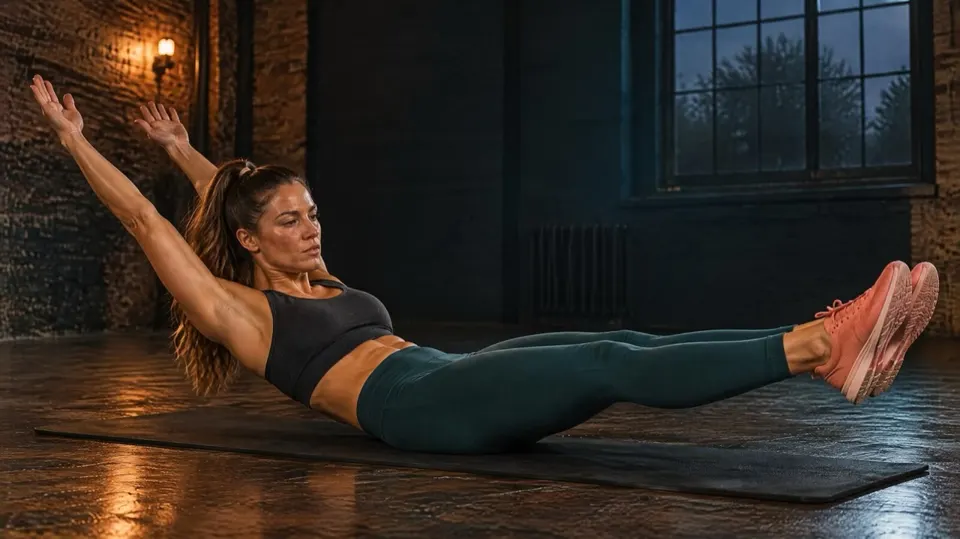
Why it works
Mat Pilates trains the deep muscles that hold you upright: your abdominals, the muscles along your spine, your glutes and the small muscles around your hips and shoulders. Slow, controlled movement and steady breathing build strength and body awareness without jumping or heavy weights.
You only need a mat or a folded blanket. Every exercise here comes from the classical mat repertoire or a beginner version of it, so the skills carry straight into any Pilates class.
Safety first
- Use a mat or thick towel on a non-slip floor.
- Move slowly and breathe out on the effort. Quality beats the number of repetitions.
- Keep your neck long. If your neck tires in curl-up moves, rest your head down.
- Stop any move that causes sharp pain, and skip deep forward rounding if you have osteoporosis or a disc problem.
- If you are pregnant or have recently given birth, check with your doctor or a women's health physiotherapist first.
The 10 exercises
- 1
Pelvic curl
Glutes & spine control- Lie on your back, knees bent, feet flat and hip-width apart.
- Breathe out and peel your spine off the mat one bone at a time until you rest on your shoulder blades.
- Breathe in at the top, then roll down slowly from the top of your spine to your tailbone.
- How much
- 6–8 slow reps
- Easier
- Lift only your tailbone and lower back.
- Harder
- Hold the top and lift one heel at a time.
- 2
The Hundred (beginner)
Abdominals & breathing- Lie on your back with knees bent and feet lifted, shins level (tabletop).
- Curl your head and shoulders up and reach your arms long beside you.
- Pump your arms up and down while breathing in for 5 counts and out for 5 counts.
- How much
- 5–10 breath cycles
- Easier
- Keep your head down and feet on the floor.
- Harder
- Straighten your legs to a 45-degree angle.
- 3
Half roll-back
Abdominals- Sit tall with knees bent, feet flat, hands lightly behind your thighs.
- Breathe out and tuck your tailbone, rolling back halfway into a C-curve.
- Breathe in to hold, then breathe out and roll back up to sitting tall.
- How much
- 6–8 reps
- Easier
- Roll back only a few inches.
- Harder
- Cross your arms over your chest, or progress to a full roll-up.
- 4
Single-leg circles
Hips & core stability- Lie on your back with one knee bent and the other leg reaching to the ceiling.
- Draw a small circle with the raised leg, keeping your hips completely still.
- Do five circles one way, five the other, then switch legs.
- How much
- 5 each direction, each leg
- Easier
- Bend the raised knee slightly and make the circle smaller.
- Harder
- Straighten the bottom leg along the mat.
- 5
Single-leg stretch
Abdominals & coordination- Lie in tabletop and curl your head and shoulders up.
- Hug one knee towards your chest while the other leg reaches out long.
- Switch legs smoothly, breathing out each time you switch.
- How much
- 8–10 each leg
- Easier
- Keep your head down and reach the leg higher.
- Harder
- Reach the extended leg lower, just above the mat.
- 6
Spine stretch forward
Spine mobility & hamstrings- Sit tall with legs straight and a little wider than your hips, feet flexed.
- Breathe out and round forward from the top of your head, reaching your arms ahead.
- Breathe in and stack back up to sitting tall.
- How much
- 5–6 reps
- Easier
- Sit on a folded towel and bend your knees.
- Harder
- Reach further while keeping your hips grounded.
- 7
Swan prep
Upper back & posture- Lie on your front with your hands under your shoulders and elbows tucked in.
- Lengthen through the top of your head and lift your chest a few inches, keeping your hips down.
- Lower slowly with control.
- How much
- 6–8 reps
- Easier
- Lift only your head and shoulders.
- Harder
- Lift with your hands hovering off the mat.
- 8
Swimming (prep)
Back, glutes & shoulders- Lie on your front with arms reaching forward and legs long.
- Lift your opposite arm and leg a few inches, keeping your neck long.
- Lower and switch sides, moving slowly.
- How much
- 8–10 each side
- Easier
- Do it on hands and knees (bird dog).
- Harder
- Lift both arms and legs and flutter them in a steady rhythm.
- 9
Side-lying leg lift
Outer hips & waist- Lie on your side in a straight line, head resting on your arm.
- Lift the top leg to hip height, keeping your hips stacked.
- Lower with control. Switch sides after your set.
- How much
- 10 each side
- Easier
- Bend the bottom knee for more stability.
- Harder
- Add small pulses at the top or circle the leg.
- 10
Forearm plank
Whole-body stability- Rest on your forearms with elbows under your shoulders.
- Step your feet back so you form a straight line from head to heels.
- Hold while breathing steadily, belly drawn gently in.
- How much
- 3 holds of 15–30 seconds
- Easier
- Drop to your knees.
- Harder
- Lift one foot at a time for a few seconds.
The routine
Work through the moves in order. Take 15–30 seconds to reset between exercises.
| Part | Exercises | Time |
|---|---|---|
| Warm-up | Pelvic curl, breathing in tabletop | 3 min |
| Core | The Hundred, half roll-back, single-leg stretch | 6 min |
| Hips & spine | Single-leg circles, spine stretch forward, side-lying leg lift | 6 min |
| Back & stability | Swan prep, swimming, forearm plank | 5 min |
How often
Two or three sessions a week is a good start for beginners. Pilates is gentle enough to do on consecutive days, so short 10–20 minute sessions most days also work well.
Once the moves feel controlled, try the harder versions or move on to the full classical mat order.
Want a plan that does this for you?
Train at Home includes Gentle Pilates Flow, the Pilates Foundations and Pilates Control series, Pilates Core, and 30- and 35-minute Classical Mat sessions, with a real trainer on video and a voice coach guiding your breathing.
Coming soon to theApp StoreFrequently asked questions
Can you do Pilates at home without a reformer?
Yes. Mat Pilates was the original form of the method and needs only a mat. Every exercise in this guide is a mat exercise.
Is Pilates good for beginners?
Yes. Pilates starts with small, controlled movements and builds gradually, and almost every exercise has an easier version.
How long before I see results from Pilates?
Many people feel stronger and more aware of their posture within a few weeks of practising two or three times a week. Visible changes take longer and depend on your overall activity and diet.
Pilates or yoga?
Both build strength and mobility. Pilates focuses more on core control and precise movement; yoga places more emphasis on flexibility, held postures and breathing practice. Many people enjoy both.
Sources
This guide is general information, not medical advice. Talk to your doctor or a physiotherapist before starting a new exercise programme, especially if you have a health condition.